

History. Before your eyes glaze over, consider that Canada is chock-full of fun ways to explore and engage kids in the past of this amazing country. And does history matter? Sure does. Consider this famous quote: “A generation which ignores history has no past and no future.” There are hundreds of amazing historic sites to get your kids energized about Canada’s history. Here are a few suggestions to get you started on your adventures.

L’Anse aux Meadows is an archaeological site, first excavated in the 1960s, of a Norse settlement dating back approximately 1,000 years. The site is located on the northernmost tip of the island of Newfoundland. Kids would find the earthen “buildings” fascinating, as well as the history of the Viking explorers.
L’Anse Aux Meadows National Historic Site, Newfoundland
At the windswept northern tip of Newfoundland, the remains of turf-walled houses and strange earthen mounds mark the earliest known evidence of European settlement in the New World. It’s believed that the Viking Leif Ericson settled there more than 1,000 years ago. Even on a cold, windy day, you can’t help but be overwhelmed by this footprint in time.
Kids can explore the bogs and coastline, climb into the sod huts of the reconstructed village, and listen to the costumed re-enactors discuss the lives of the Nordic visitors at the only recognized authentic Viking site in North America to date. They can even dress up as a Viking and snap a selfie. https://parks.canada.ca/lhn-nhs/nl/meadows
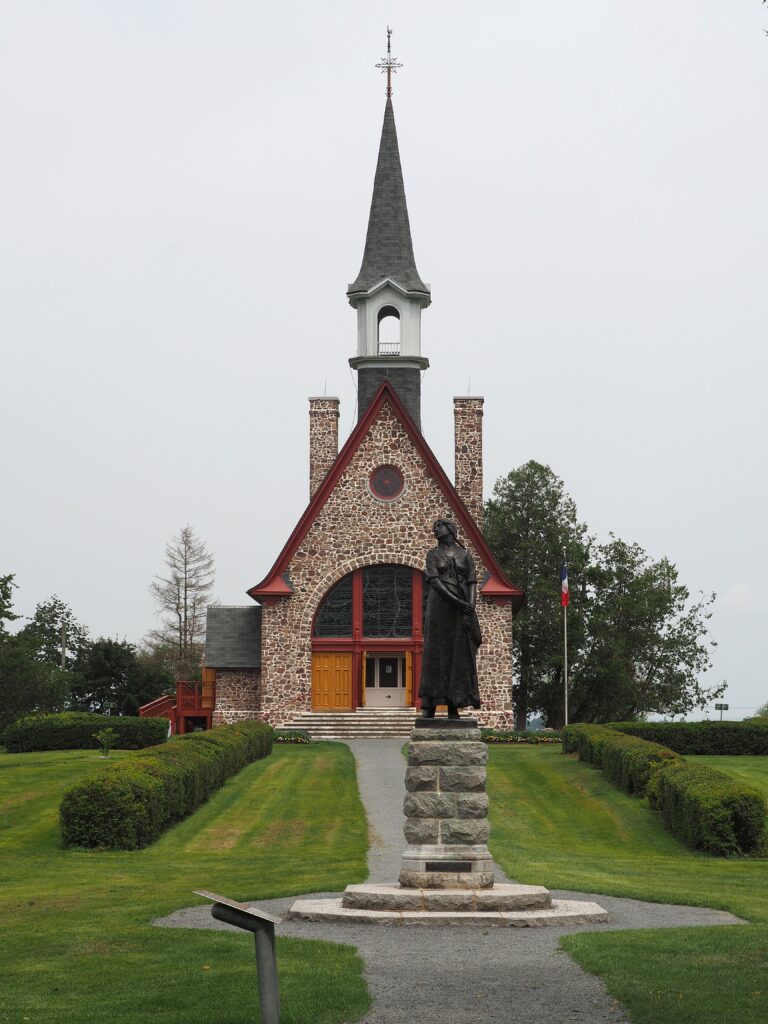
The Statue of Evangeline outside the Memorial Chapel at Grand-Pré tells the story of a love torn apart by the Deportation of the Acadians.
Grand-Pré National Historic Site, Nova Scotia
There is wide-open space for kids to run around at Grand-Pré. The UNESCO World Heritage Site tells the story of the Acadian people and the tragic Deportation of 1755 to 1762. Acadie was a territory settled initially as a colony of New France.
The Acadian settlers arrived in the early 1680s but refused the British demands to sign an allegiance to bear arms against the French. They were rounded up, their homes burned to the ground, then loaded onto ships and deported to colonies along the eastern seaboard. Almost half the Acadians escaped the deportations and moved inland to places like New Brunswick and Quebec.
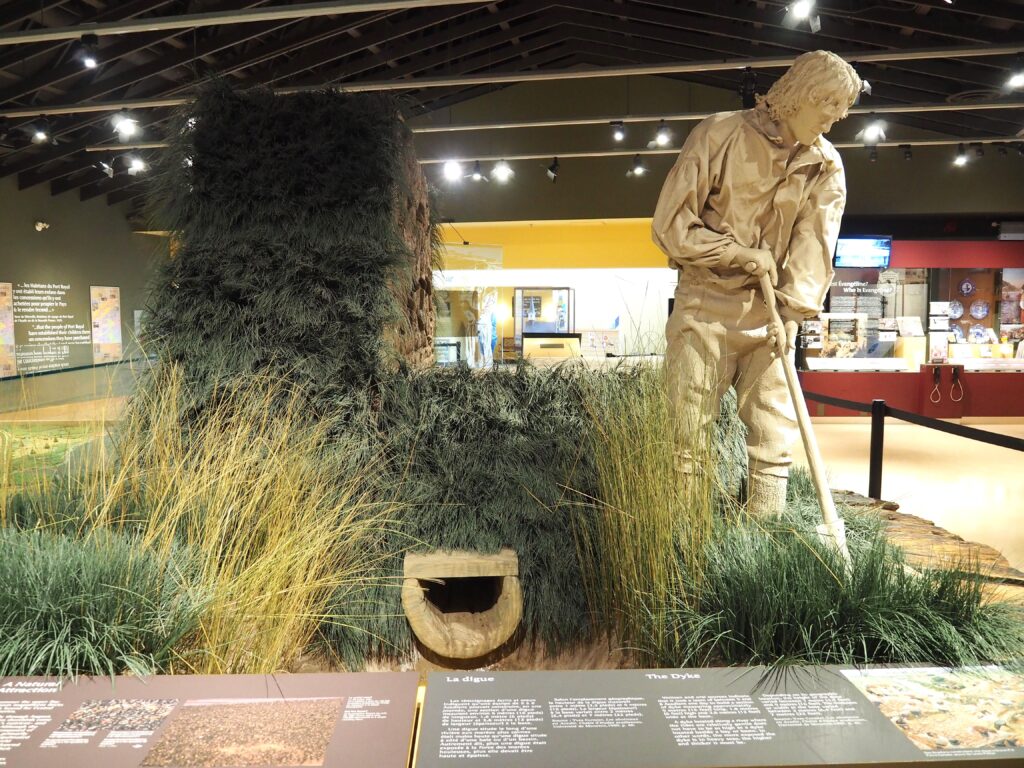
The small museum at Grand-Pré shows the inventive method of dykes used by the Acadians to create fertile land from the salty marshes.
While the Deportation is the main history told at the site, the museum—and the surrounding landscape—show the story of how the industrious Acadians built a system of dyking and desalination to reclaim the salty tidal marshlands and turn them into soil so rich and fertile that it was known as “the breadbasket of Acadie.”
There’s a museum with replicas of the hollowed-log dykes and the wooden sluices. The artwork and artifacts inside the Memorial Church will give kids pause to think about some of the hardships faced by the people who formed what became Canada. https://parks.canada.ca/lhn-nhs/ns/grandpre
New France Festival, Quebec
Founded in 1608 by explorer Samuel de Champlain, Quebec City was once the capital of New France and the cradle of civilization in a French empire that stretched to Louisiana. Kids love hearing about explorers!
The annual New France Festival (held in August) is a time warp that brings the history of the 17th and 18th centuries to life. Locals and visitors alike embrace everything that makes Quebec unique—its history, language, food, music, and dance. The stone ramparts, squares, and narrow streets are taken over by street performers, acrobats, jugglers, markets, and music that show how the first settlers lived, dressed, ate, and celebrated.

Face painting is popular with kids visiting the annual New France Festival in Quebec City.
Locals and visitors can join in the joie de vivre by dressing in attire from that period (rentals available). Children of all ages can choose between peasant and bourgeois attire and become part of the celebrations.
Quebec City is challenging for RV parking. An alternative is to park on the south side of the St. Lawrence River at Levis and take the quick ferry to Old Quebec City. https://nouvellefrance.qc.ca/en
Rideau Canal National Historic Site, Ontario
After the War of 1812, it was clear that the St. Lawrence River—Britain’s only supply route between Montreal and the Great Lakes—was vulnerable to attack. The Rideau Canal—considered an “engineering marvel”—was built as a safer route connecting Kingston and Ottawa through a system of 47 locks at 24 lockstations.
Kids love to watch the boats and vessels rise and descend as the locks are filled and emptied with water. The gated chambers function like balancing scales, raising, or lowering water levels to enable boats to navigate around obstacles such as waterfalls or rapids. At most of the Rideau locks, the Parks Canada staff still use the original hand cranks to open and close the doors of the massive water chambers. Our favourite is at Jones Falls with a swimming spot, hiking trails, a series of locks, a working blacksmith shop, and the lockmaster’s house. The parking lot is RV-friendly. https://parks.canada.ca/lhn-nhs/on/rideau
Fort Henry National Historic Site, Ontario
Fort Henry is a UNESCO World Heritage Site and a living history museum in Canada’s largest fortification west of Quebec City. Once called the “Citadel of Upper Canada,” it sits on the crest of a peninsula with commanding views over the St. Lawrence River, built to guard the entrance to the Rideau Canal. The parking lot is easily navigated for even the largest of RVs.
Behind the stone walls are tunnels and vaulted casements, a schoolroom that kids love, and 19th-century British military reenactments in the parade grounds. The world-famous Sunset Ceremony is a showcase of pomp, circumstance, and thundering cannons.
Explain to the kids how the fort’s stone-block casements were considered bombproof and state-of-the-art. The red brick ceilings and stone walls are all original, complete with narrow, defensible rifle slits cut into the thick blocks of limestone. www.forthenry.com

The Big House at Fort Garry was once the headquarters of the North West Mounted Police as well as an administrative headquarters for the fur trade under the Hudson’s Bay Company.
Lower Fort Garry National Historic Site, Manitoba
At the height of the thirst for fur, the North West Company built 97 trading posts, slightly outnumbering the 84 belonging to the Hudson’s Bay Company. In 1821, the rival companies merged to create the Hudson’s Bay Company, ushering in a period of sedate and profitable trade.
In days gone by, Lower Fort Garry was the primary business site for the entire Red River Settlement. Today, it’s the oldest intact stone fur trade post in North America, revived to its 1850s appearance as a bustling supply centre and a testament to the history of the fur trade and the life of the voyageur. Costumed interpreters take on the roles of guides, voyageurs, trappers, and settlers, operating the blacksmith shop, fur loft, Métis encampment, and Government House.
Look for the plaque that commemorates the historic signing of Treaty #1, the country’s first treaty signed between Canada and the seven chiefs of the Anishinaabe and Swampy Cree First Nations, which created the foundation of modern Manitoba. https://parks.canada.ca/lhn-nhs/mb/fortgarry
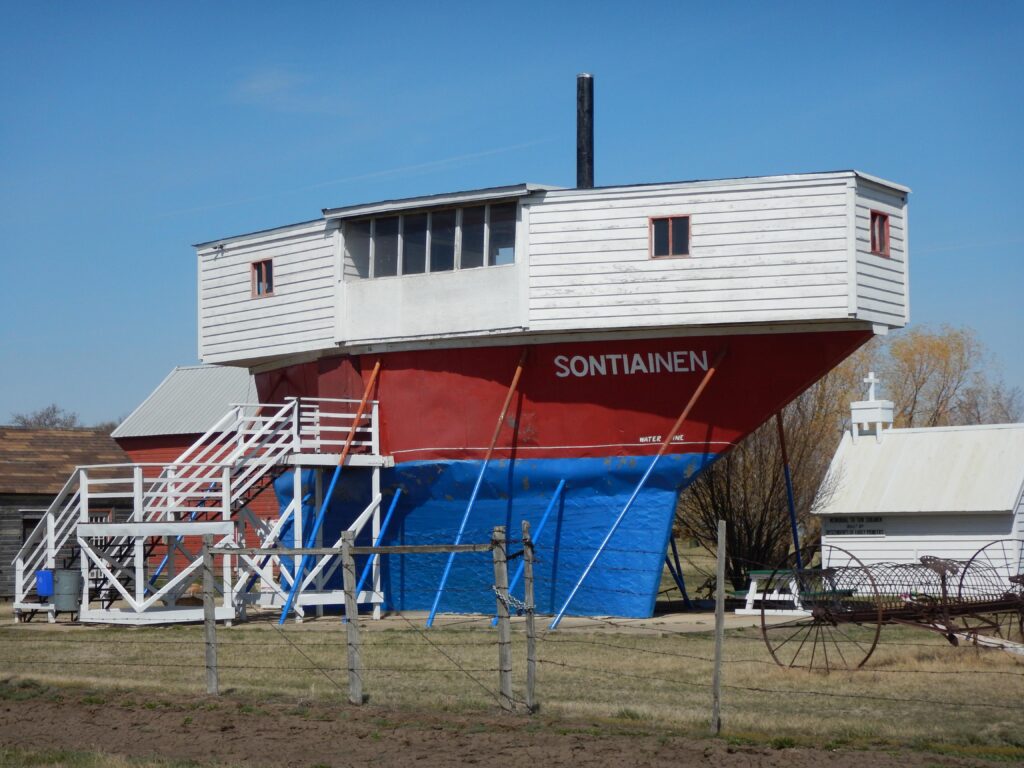
Photos courtesy of Sukanen Ship Museum.
Sukanen Ship Pioneer Village & Museum, Saskatchewan
It’s a strange sight—a sea-worthy vessel parked in the middle of the flat, dry prairie. Nevertheless, there it is, rising like a mirage, with not a single puddle in sight.
The story of the ship starts with the persistent drive of a homesick immigrant who just wanted to escape his crumbling life during the Great Depression, build a boat, and sail home to Finland.
After losing his family and farm in the early 1900s, Tom Sukanen studied maps and water levels to determine the best locations for his settlement. He discovered that, although it seemed like a wild idea, with enough water in the Saskatchewan River, there was a way to sail a boat to Europe from the middle of Canada. The “Crazy Finn” was obsessed with building the ship of his dreams and ignored his farm work, but it hardly made any difference since the Prairies were in the grip of a drought, and instead of crops, the land produced just dust storms and grasshoppers.
Tom designed The Donquian in three sections, with a plan to float the parts up the river to Hudson Bay, where he would assemble them for the more treacherous ocean crossing. But vandals attacked and destroyed his years of work, leaving the boat beyond any hope of repair.
Volunteers at the Sukanen Ship Pioneer Village & Museum have rebuilt Tom’s ship, keeping the memory alive of the Finnish seafarer who wanted to go home. Tom was buried beside his beloved boat, a monument to the indomitable human spirit of the Canadian pioneer. https://www.sukanenshipmuseum.ca

Inside the Visitor Centre, the displays show how the cliffs would have been used as a hunting tool.
Head-Smashed-In Buffalo Jump, Alberta
This UNESCO World Heritage Site is a great way for kids to learn about bison, the continent’s largest terrestrial mammal that once dominated the Great Plains. Of the 250 known buffalo jumps in North America, Head-Smashed-In Buffalo Jump is the largest, oldest, and best preserved.
For thousands of years, tribes like the Blackfoot were dependent upon the massive animal. It provided them with meat, tools, hides for clothing, and shelter; whoever controlled the buffalo was a very powerful people.

The cliffs at Head-Smashed-In Buffalo Jump in Alberta.
Head-Smashed-In Buffalo Jump is a landscape of steep cliffs, surrounded by grasslands. It was the prime hunting area for buffalo, where the main method was the buffalo jump —a sophisticated hunting technique in which herds were lured, stampeded over cliffs, and then butchered at the bottom. Beneath the cliff, the remains of bones and tools from 5,700 years of hunts are more than 10 metres thick.
According to First Peoples’ telling, the name of the spot comes from the story of a little boy who climbed into a crevice on the cliff to see the buffalo hunt up close. He was hit on the head and knocked down into the falling herd. More buffalo piled on top of him, and his skull was crushed. www.head-smashed-in.com
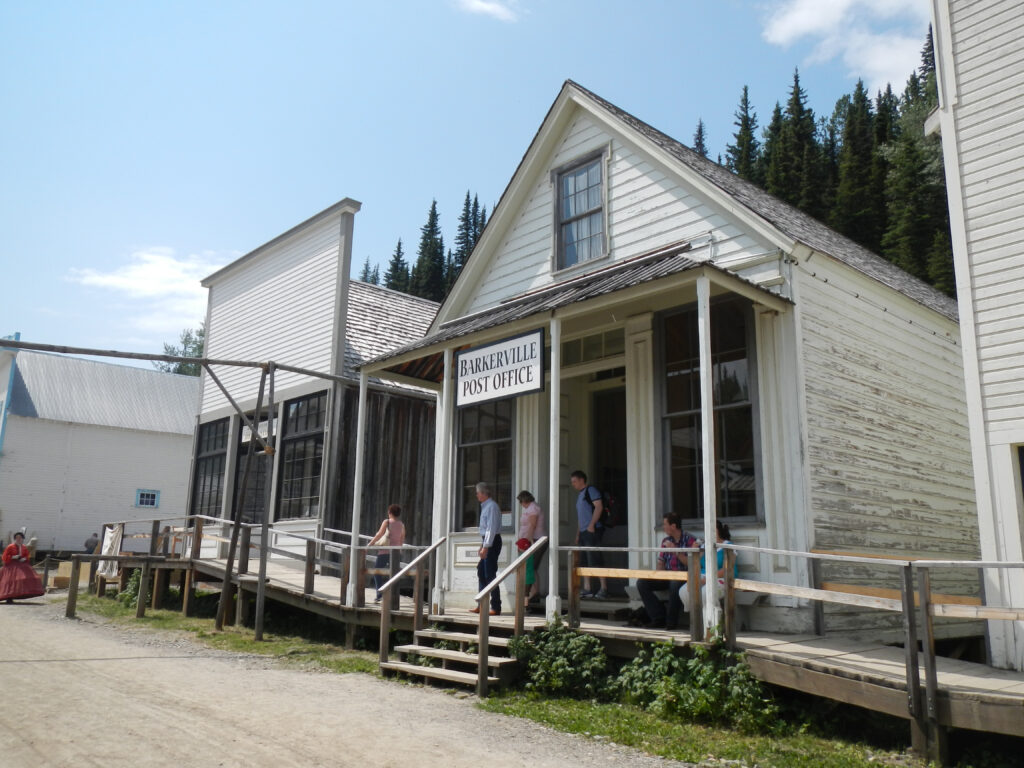
Barkerville National Historic Site is a small-town recreation of the era of the Gold Rush in central B.C. It’s a great way for kids to learn about life at that time.
Barkerville National Historic Site, British Columbia
In 1862, Billy Barker’s discovery of gold triggered a stampede to the goldfields of central British Columbia, an area known as the Cariboo region. Barkerville was ground zero—a lucrative strike along Williams Creek marked the richest single gold-plated creek in the world.
Barkerville is the largest living history museum in western North America. More than 130 period buildings—from the saloon to the Chinese ‘wash-and-dry’ laundry—line the streets. Most of the original Barkerville buildings stand in their original locations. Interpretive guides wear the dress of the era, walking the streets, operating the shops, and playing their parts to the hilt. A loaded stagecoach rattles along dusty roads, the driver calling out stops along the way. The clang-clang-clang of the blacksmith striking his anvil rings out in the mountain air. It’s period history—and fun—for kids.
There are two nearby campgrounds which can accommodate most trailers and RVs. www.barkerville.ca
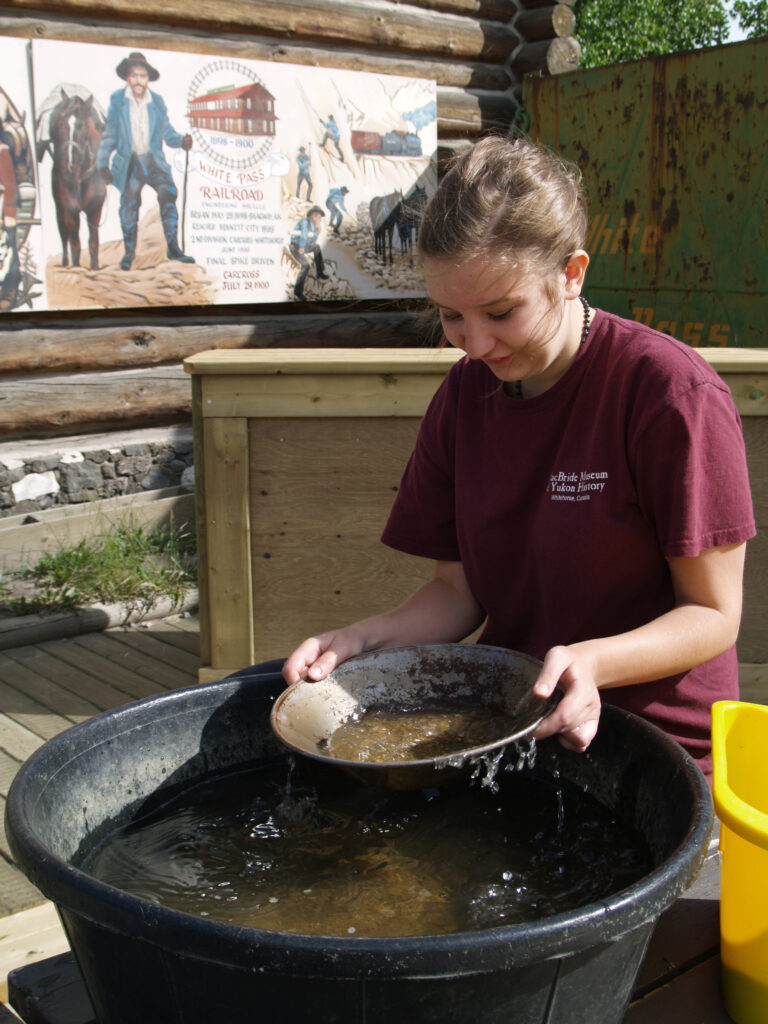
Kids can take a hand at panning for gold at the MacBride Museum in Whitehorse.
MacBride Museum of Yukon History, Yukon
Nothing shaped the history of Whitehorse like the Klondike Gold Rush of the late 1800s, when an estimated 100,000 prospectors crossed through town before beginning their trek north to Dawson City, braving the wilderness of an unknown land in their quest for riches. They were a quirky, strong bunch who left their stamp on the Yukon’s history, architecture, and frontier mentality.
The newly expanded MacBride Museum of Yukon History is a treasure trove of the territory’s largest collection of cool historic items. Exhibits highlight the traditions of First Nations culture, the history and role of the Royal Canadian Mounted Police, the territory’s rich mining history, and the significance of the Klondike Gold Rush.
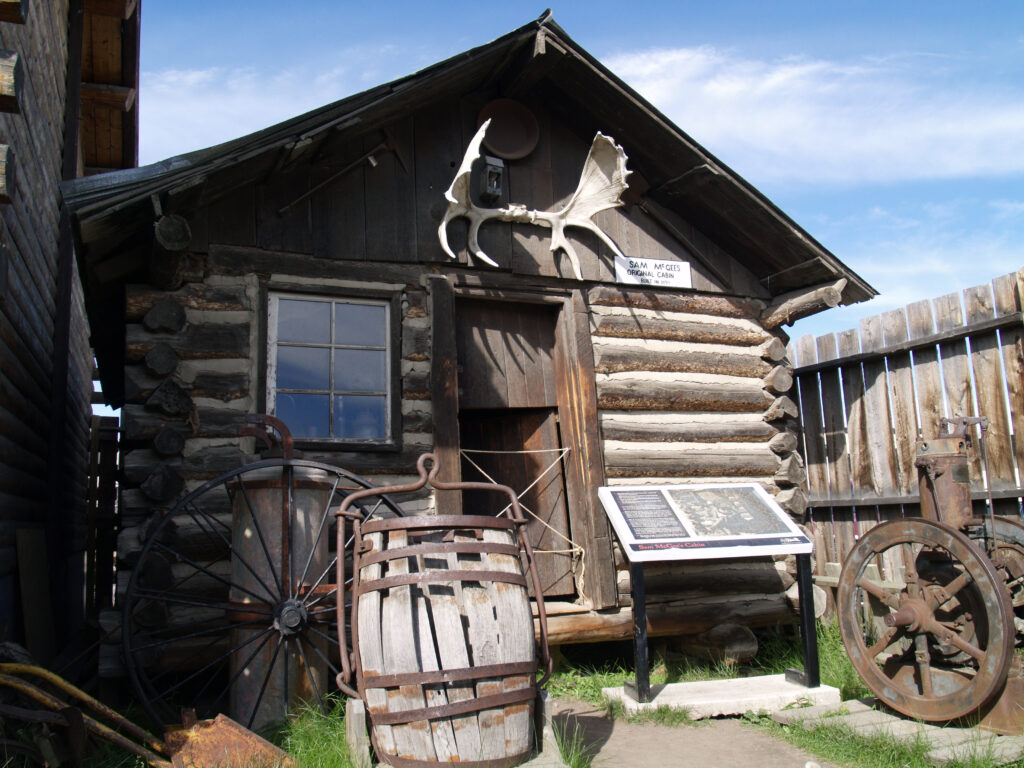
One of the highlights at the MacBride Museum is the actual cabin of prospector Sam McGee, made famous in the poem, The Cremation of Sam McGee.
Onsite is the original cabin of prospector Sam McGee, who was immortalized in Robert Service’s poem, The Cremation of Sam McGee. https://macbridemuseum.com/visit/macbride-museum
Close by, in downtown Whitehorse, the carefully refurbished S.S. Klondike National Historic Site is open for public tours in dry dock. The craft was the largest sternwheeler to travel the upper Yukon River in an era when steam-powered riverboats shuttled cargo and passengers between Whitehorse and Dawson City. www.parkscanada.gc.ca/ssklondike
Related Articles
What’s New for 2025 – Towables
The sales boom and bust from the pandemic are finally over. Frankly, that's good for all of us as RV shipments gradually return to standard numbers. That means pricing should stabilize, and some quality issues caused by hurry-up production during the pandemic...
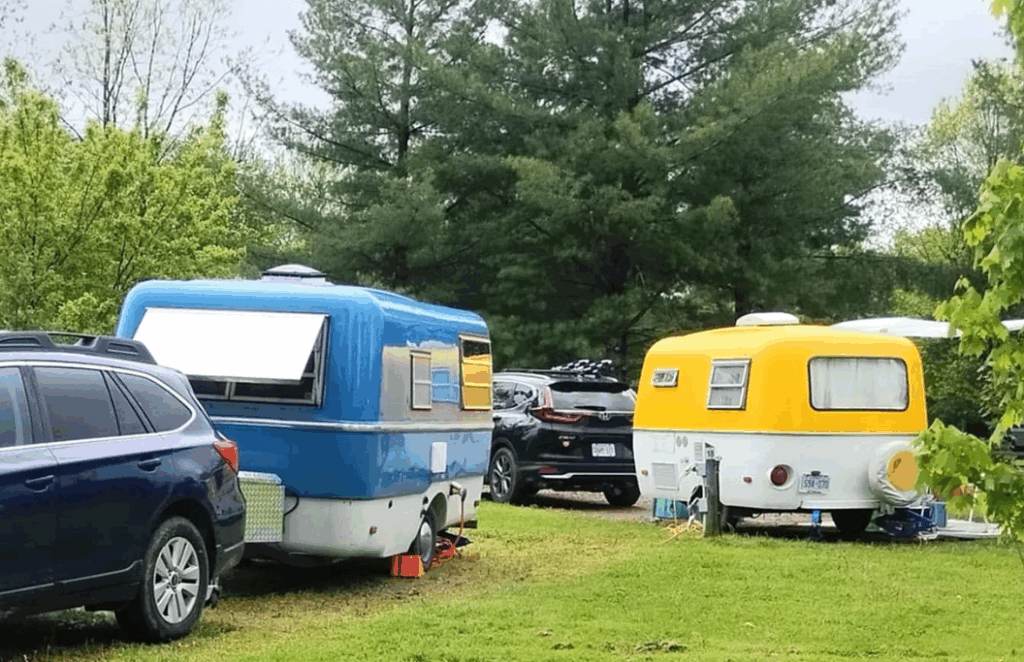
Eggfest Ontario 2025: Vintage Trailers Take Over Rideau Acres
Licence plates from across Canada and the USA adorned the quirky convoy as approximately 150 vintage trailers rolled in for the rally, Eggfest Ontario 2025. "If you happened to be driving past Rideau Acres Campground the weekend of May 23-25, you might have thought...
Canadian RV Innovators: Sweat, Tears, and the Rise of Van Life
Freedom Reimagined Freedom on the open road has always been a Canadian dream: through the Rockies, along Maritime coastlines, and deep into northern wilderness. In the past decade, that dream has taken a new shape: van life. Once a fringe idea, it has become a...