Why do I love diesel? I blame my father. In 1970 I was twelve years old, sitting home during March break. The phone rang and my dad asked me, “do you want to go to Florida?” Of course I did. “Well pack a bag and I’ll be home in 20 minutes to get you.”
In 1970 my dad owned a large machine shop in Toronto and from time to time he did some welding and other work for an independent trucker that he became friends with. This friend, Bernie, hauled oranges from Lakeland, Florida, to the Queensway produce terminal in Toronto once a week. He offered to let me ride along. This was the start of my love of trucks and diesel. A week spent in that big cabover Freightliner (called a White Freightliner back then) had me hooked. From then on, for me, it was all about trucks.
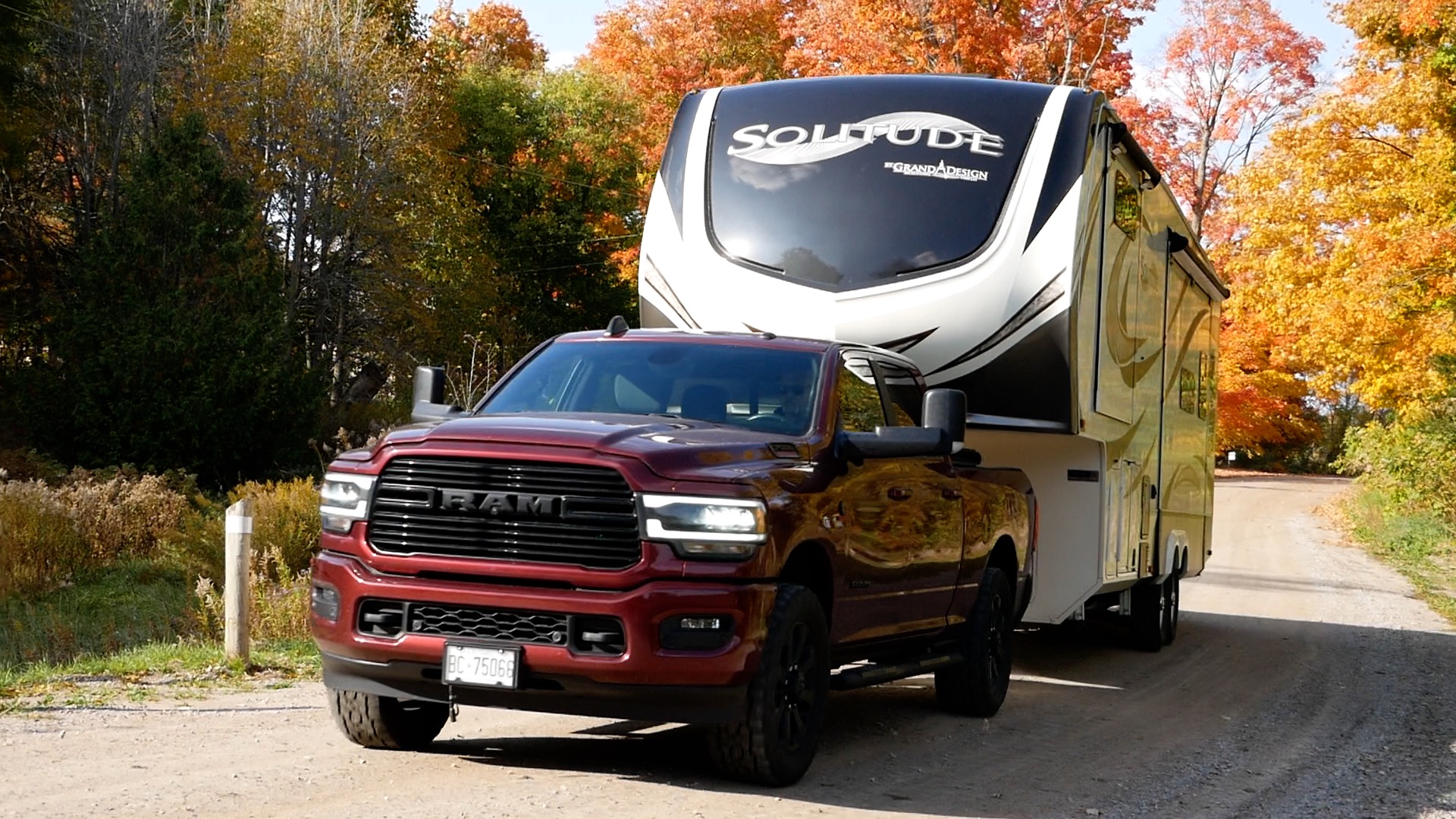
My first “car” at sixteen was a Ford F250; just the first of many pickups. In 1983 I got my Class A licence – a fact that helped me put food on the table when I went back to college to finish my journalism degree in ’94 driving a steel truck at night. I also owned a ’78 International Transtar with a partner/driver for a time. I’ve had many half-tons over the years, but, when it came time to buy my first HD to haul my RV I had to have the Ram with the Cummins and when I switched up to Chevy, of course, I opted for the Duramax diesel in my 3500 HD. So, as I said, I blame my dad – he gave me the bug that has me loving diesel.
OK, how does this snippet of my life explain anything about gas vs. diesel? Well, for the first time I am considering gas, and I want to lay out the thought process that leads to an engine choice. When ticking that box on the new truck order form you cannot just look at practicality—you just can’t. The wild card is found in one word: love. We buy what we love, and as we all know love rarely makes sense. Before I lay out the cold, practical analysis that may lead you (or me) to choose the gas engine option, you must consider the power of love as part of the purchase equation.
All this started as I finished calculating (and collecting) all my records for my 2025 taxes. I looked at my mileage for the year – 15,000 km, that’s it. The year before, 17,500 km. I must admit that I am no longer a hi-miler. That fact is what has me going down this rabbit hole – that and I also had a Ford F350 with 7.3L Godzilla engine on loan, that I really liked – so I had some fuel economy and dollar data from that experience. Then I looked at the fact that on my winter trip to Alabama and back I logged 7,000 km, almost half my year’s total. You get the picture – one that is similar to many RVers. Drive a lot and then sit for months. So, with this amount of usage – do I really need an expensive diesel in my truck?
Here is the way I started to look at this case. If I was driving 50,000+ km a year, I doubt I’d be considering the change—but I don’t drive enough. So, even though I love my diesel, I am going to try and make a rational decision on what should power my next truck.
Key factors to consider
• Purchase price: The price difference for a Ford F-350 equipped with the 7.3L gas engine vs. the 6.7L Power Stroke diesel is between US$9,000 and US$11,000 upfront.
• Longevity: A 6.6L Duramax is often cited at 500,000–800,000 km. Ford’s 7.3L “Godzilla” gas V8 is often cited at 400,000–500,000 km. If you’re 30, this matters. I’m 68 this year, so…
• Power: Ford 7.3L “Godzilla” gas V8: 430 hp / 475–485 lb-ft torque; GM Duramax 6.6L V8 turbo-diesel: 470 hp / 975 lb-ft torque.
Gas engine
Positives
1. Cheaper fuel (in most regions of North America—though not all).
2. Simpler maintenance.
3. Cheaper oil changes, filters, etc.
4. No DEF to add.
Negatives
1. The gas engine has roughly half the torque of the diesel.
2. Tow rating for gas is about 20% lower.
3. Gas doesn’t pull as hard or as consistently under load.
4. It revs at much higher RPM and is slower on steep grades.
Diesel engine
Positives
1. Available engine exhaust braking.
2. Diesel fuel can offer up to ~40% more km per litre (varies by vehicle and conditions).
3. A diesel engine may last longer than a comparable gas engine (usage/maintenance dependent).
4. Higher tow ratings.
Negatives
1. Filters and oil changes are more expensive.
2. Cost of DEF.
3. If any part fails on a diesel, it’s much more expensive to repair.
A couple of other things to consider:
On the plus side: Most consumers don’t know that there is 20% to 40% more energy in a litre of diesel fuel. Put another way, if a litre of gasoline will propel your car 10 kilometres, a litre of diesel fuel will push the same vehicle an additional 2 to 4 kilometres further down the road.
While the cost of DEF is a dollar item, it’s also a complex component. The exhaust-gas scrubbing system it supports can also be a problem if it goes bad. Consider that, through chemical reactions, the NOx and ammonia convert into harmless inert nitrogen and water. Dosing occurs between 200 and 500 degrees Celsius. The final step in the cleansing of diesel exhaust gas is the Diesel Particulate Filter (DPF). The DPF traps soot, which is then periodically burned away (regeneration) when sensors detect the trap is full, at temperatures of up to 600 degrees Celsius.
Alright, let’s get to the money. Winter of 2025 was spent in Gulf Shores, Alabama. I have all the data and receipts for that trip, so I’ll compare the Duramax performance to the possible performance of the Ford 7.3L gas engine.
The total trip was 7,000 km (4,300 miles) towing my 15,000 lb fifth-wheel to Alabama and back. (As this trip was in the United States I am using miles and US dollars here with some kilometre conversions in brackets.)
DURAMAX – 4,300 miles (6,920 km) at 9.8 mpg (24L/100km) = 439 gallons of diesel x $3.70 USD = $1,624
GODZILLA – 4,300 miles (6,920 km) at 8.2 mpg (28.6L/100km) = 525 gallons of gas x $3.10 USD = $1,628
The rest of my driving year is 90% empty – here are those numbers.
DURAMAX – 5,000 miles (8,047 km) at 20 mpg (12L/100km) = 250 gallons of diesel x $3.70 USD = $925.
GODZILLA – 5,000 miles (8,047 km) at 13 mpg (18L/100km) = 385 gallons of gas x $3.10 USD = $1,194.
With these numbers I can look at my total 2025 fuel cost gas vs diesel.
DURAMAX = $2550.
GODZILLA = $2822.
That’s just under US$300 difference in favour of the diesel for all of 2025.
With all this data I can coldly calculate that I am better off with the gas engine based on my usage. Even though it breaks my heart to give up my diesel. We’ll just have to see…
Related Articles

What’s New for 2025 – Towables
The sales boom and bust from the pandemic are finally over. Frankly, that's good for all of us as RV shipments gradually return to standard numbers. That means pricing should stabilize, and some quality issues caused by hurry-up production during the pandemic should...
Top tips for planning a successful RV trip
Without leaps of imagination or dreaming, we lose the excitement of possibilities. Dreaming, after all, is a form of planning.- Attributed to Gloria SteinemBefore there’s a plan, there’s a dream. That’s the first step in any plan. Start your planning early by asking...
Coasting Through Oregon
Each fall, my wife Sandy and I head south from British Columbia in our RV to spend the winter in Arizona or California. Over the years, we’ve taken several routes south through Oregon. However, coastal highway 101, bordered by the Pacific Ocean to the west and the...